A Study in Glass
Rock Gods and Genomes layers the past, present, and the future to explore humanity’s obsession with immortality and our eternal troubled relationship to religion, nature, art, and STEM. Who gets to author humanity’s future?
What do we worship and why?
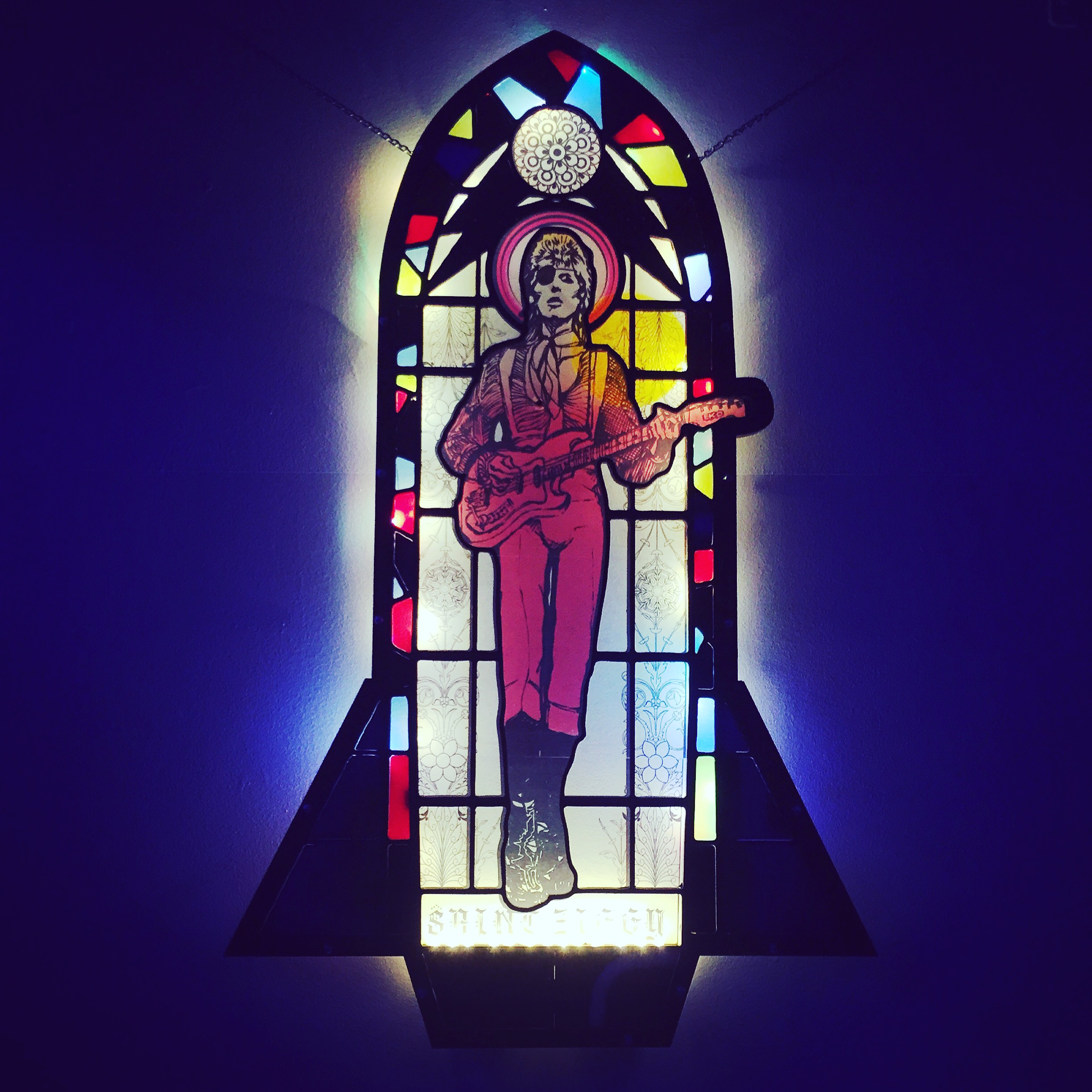
Traditionally associated with an analog world and sacred storytelling, stained glass becomes a vehicle for examining modern worship: celebrity, innovation, and the increasingly blurred boundary between human and post-human identity.
The series pairs portraits of iconic musicians with genomic imagery. Figures such as David Bowie, Nina Simone, Jimi Hendrix, Bob Marley, and Freddie Mercury are portrayed as saints or deities suspended in cathedral windows; illuminated cultural icons whose influence continues beyond death. Included are visualizations of real gene sequences relevant to each “saint”. The figures hail from a time of social unrest and political upheaval that echoes profoundly in 2026.
This work offers a lens on what’s replaced traditional faith structures, and asks if our ideas of godhood have changed. Rockstars function as secular saints: publicly transformative figures who challenge cultural norms, inspire devotion, and embody both liberation and destruction.
Conceived in 2017 around CRISPR and citizen biotechnology, the project has taken on new depth in the age of AI and social media. Today, tech culture increasingly mirrors religious structures, with tech oligarchs, algorithms, and optimization systems promising new forms of transcendence, permanence, freedom from accountability, and control. The 2026 edition of this project now also examines algorithmic power, machine learning, and the rise of techno-monotheistic culture.
Rock Gods and Genomes examines our past, present, and future mythologies, questioning not only what we worship, but why.
Rock Gods and Genomes layers traditional art making methods with emerging technologies.
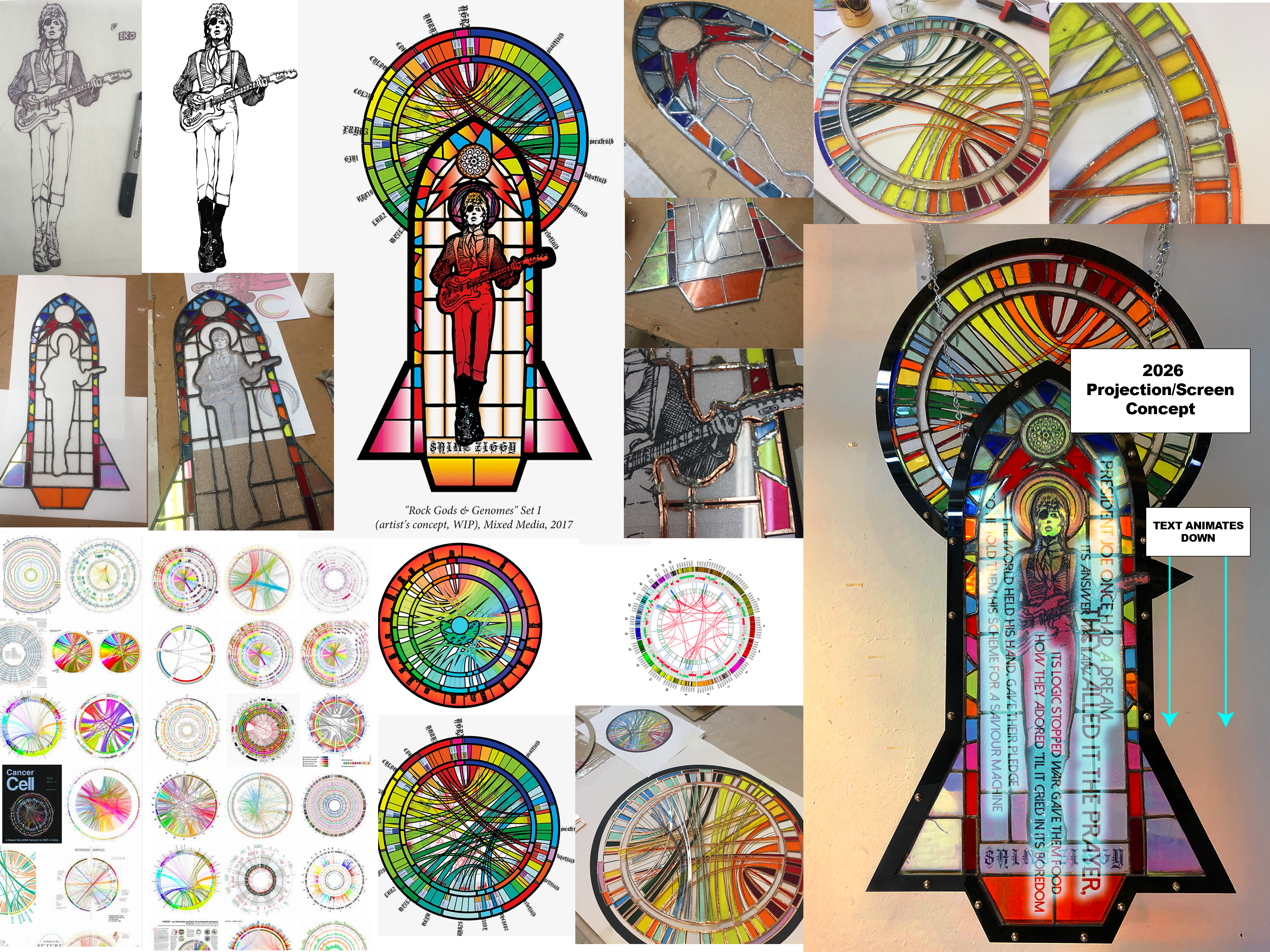
The project is structured around two visual systems: figurative portraits of influential musicians and data visualizations generated from real genetic information. The pieces are created using traditional stained glass techniques alongside newer mediums including acrylic, illumination, video, and live data streams.
The portraits are designed in the visual language of religious stained glass, drawing inspiration from cathedral iconography and devotional imagery. These “Rock Gods” intentionally reference sainthood, and canonization, positioning cultural figures within a lineage of worship historically reserved for religious imagery.
The second visual system consists of genetic data translated into stained glass compositions. These genetic sequences are relevant datasets connected conceptually to each musician portrayed. Genome information is processed through visualization pipelines and transformed into radial compositions inspired by familiar spiritual motifs, particularly circular synagogue windows and sacred geometry.
Some datasets are publicly available or research-based, while others involve speculative or modified sequences. Earlier development for the project involved time spent at Genspace, a nonprofit community biology laboratory focused on citizen science and public access to biotechnology tools. This connection was important conceptually as much as technically, acknowledging the importance and complexity of democratizing powerful technologies often limited to institutional spaces.
New works incorporate relevant song lyrics and live data generated through hashtags connected to each figure or theme. These shifting streams of language and imagery become part of the installation, functioning as a contemporary form of collective commentary: expressing memory, devotion, performance, and myth-making. The hashtags are scraped from social media and projected onto or behind the glass (site specific).
 2026 Lineup
Savior Machine, (David Bowie) DRD4-7R dopamine receptor variant + cancer resistance markers
Light Up the Darkness, (Bob Marley) cannabis genetics + overlapping haplogroups
Four Women, (Nina Simone) HeLa cell line (authorized sequence) + four African haplogroups
This Is Not Here, (John Lennon) MAOA gene, CDH13 gene + serotonin mapping
Heroine, (Janis Joplin) floral genome mapping + heroin
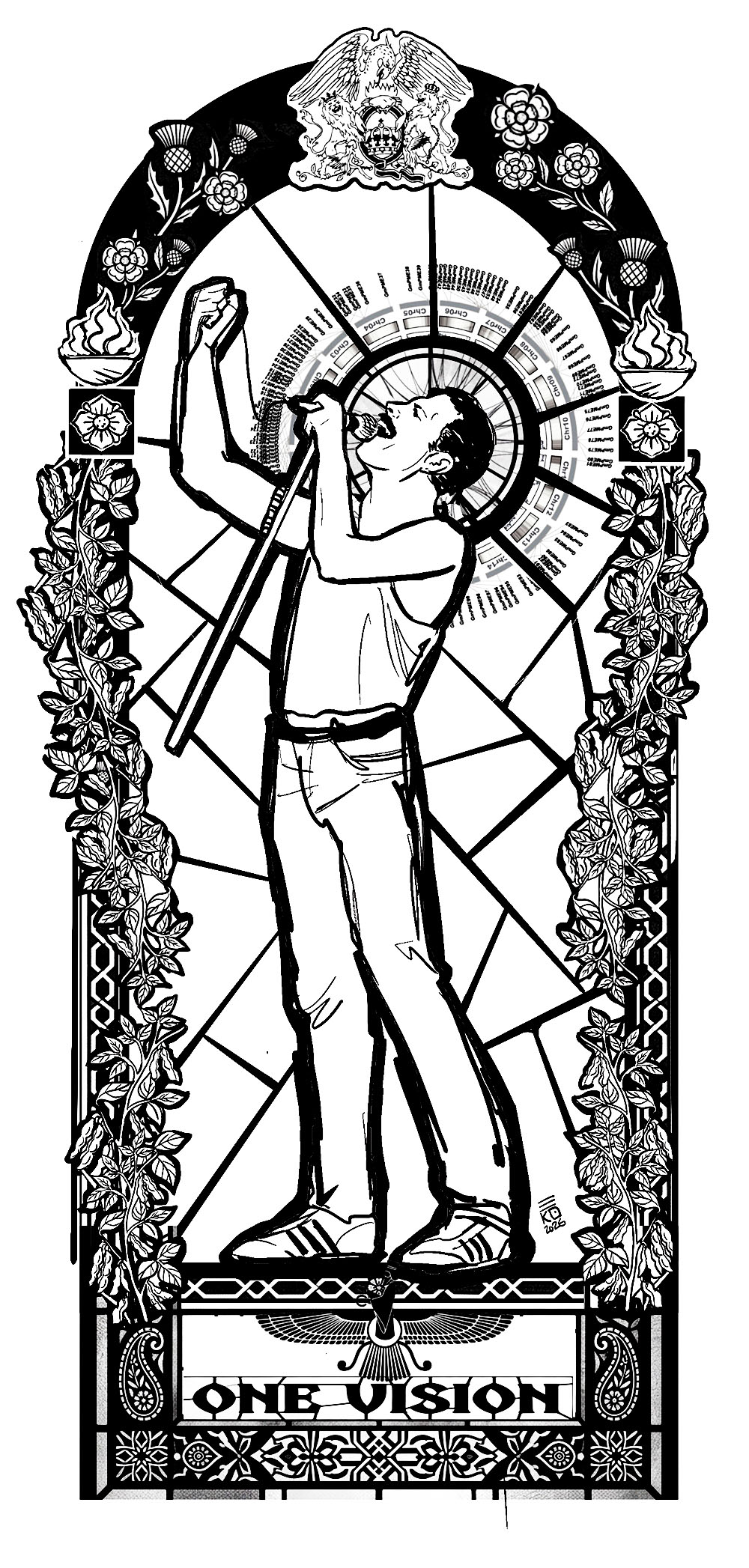
One Vision, (Freddie Mercury) overlapping haplogroups + genetically modified soy genomes
Experience, (Jimi Hendrix) DMT mapping, dopamine pathways + gunshot residue DNA
Proposed List of Sets & Underlying Concepts
The reader will notice these figures all come from roughly the same time period; one of great struggle and change, which the artist feels connects to our current tumultuous times. These designs are still in progress, or outright conceptual. Rock Gods are listed in order of preference. Genomes are open to suggestion/change.
Savior Machine (David Bowie) DRD4-7R dopamine receptor variant + cancer resistance markers
David Bowie challenged and changed everything. It’s difficult to find an area of culture this Brit-turned-New-Yorker didn’t affect. He was consistently his own fluid (re)creation, was light years ahead of the crowd. The current genome is a gene that shows some resistance to cancer. Of course, cancer is one of THE Biggest medical challenges in modern life. Tied to that is monumental hope and hubris.
The RS-RS- Gene combo is part of the genetic mapping related to what some think makes a person ambidextrous. The answer is complex, unresolved, and still being explored. Additionally, Bowie has been the most inspirational artist in my own life. This is the figure I am most interested in portraying.
Light Up the Darkness (Bob Marley) makeup of cannabis + overlapping haplogroups
Bob Marley was an activist. He brought attention and gave dignity to a largely invisible population. His life’s work directly challenged the forces of colonialism, while spreading a message of love.
Cannabis was more than a mere drug to Marley; it was a key part of his religious identity and his meditative practices. That identity was important for his followers, who became empowered through his music.
The overlapping haplogroups are symbolic of Marley’s origins; his family was a mix of Afro-Jamaican, white British Jamaican, and Syrian Jewish. Directly a product of colonialism, it’s poetic and poignant that his work addressed it.
Four Women (Nina Simone) HeLa cell line (authorized sequence), + 4 women (4 haplogroups from Africa)
Nina Simone was raised in a restrictive Christian household; so much so that she had to change her name so she could pursue a life of music. What the restrictions of dogma may spawn are always fascinating; Simone defied category musically, was at the forefront of 60’s and 70’s activism, and yet still struggled privately all her life, eventually being diagnosed with bipolar disorder in the 80’s.
Simone was a champion of black women via her existence, but also directly through her music. One of her most famous works “Four Women” illustrates the stereotypes of black women in America as they directly relate to slavery. Simone often challenged standard eurocentric notions of beauty and -arguably- humanity.
Henrietta Lacks was a poor black woman and unwitting donor of cells (HeLa cells) which served as the cornerstone of medical research and the resulting multi-billion dollar empire. Neither she nor her family was compensated.
This Is Not Here (John Lennon), MAOA gene, CDH13 gene, + mapping of serotonin
Arguably one of the greatest proponents of world peace, John Lennon was a violent individual who struggled with aggressive tendencies all his life. He spent time in India looking for a guru (briefly found in Maharishi Mahesh Yogi) but became disillusioned. What happens when our teachers are revealed as imperfect beings, when we see their flaws?
Recent studies show a possible connection to individuals who possess both MAOA and CDH13 genes and violent behavior. The beauty of these studies is that they are far from 100% conclusive.
Heroine (Janis Joplin), mapping of various flowers + heroin
A driving force in 1960’s women’s liberation, Joplin was so controversial she was rejected by many feminists of her time. She owned her sexuality, yet did not bow to conventional rules of beauty or “feminine” behavior. She wasn’t afraid to explore her sexual identity, desires, or vulnerability. Despite her ongoing struggles with addiction, Joplin was a hero. She broke many gender-biased rules that were especially pronounced in post-war America, freed women of that time in ways others are yet to be liberated. She was a proponent of the psychedelic sixties, a badass flower child. She died of a heroin overdose at the very young age of 27.
Flowers (Poppies and others – TBD) are a perfect symbol of female sexuality, of Janis’ brief beautiful life, and the era in which she bloomed.
One Vision (Freddie Mercury), overlapping haplogroups + genetically modified soy
Another product of colonialism and in this case, religious conquest, Mercury was a Parsi boy named Farrokh, born in Zanzibar, long before he was Freddie from London. The Parsi people are Persians who fled to India from religious persecution at the hand of Muslim Arabs. When the British Raj came on the scene, they got on well, as an insular, pale skinned group in-kind. From this complex background came an individual who was never afraid of shining as himself. The overlapping Haplogroups represent the history Mercury hails from.
One of Queen’s most notable performances was at the 1985 Live Aid concert, the goal of which was to help the elimination of famine in Africa. From this concert theoretically came the song “One Vision”. The Genetic modification of crops, soy being the largest, is a nice bridge between the ideas of curing world hunger, uniting towards a single cause, and ironically (given Freddy’s origins) promoting the homogenization of the world.
Experience (Jimi Hendrix), Mapping of DMT, Dopamine, + gunshot residue DNA
Jimi Hendrix was a man of action, of experience. Before becoming one of the world’s most influential guitarists, he was a paratrooper in the military. After jumping out of planes and being generally rebellious for about a year, he was honorably discharged and began his music career in earnest. Hendrix has almost too many seminal moments to capture; he was an experience for anyone who encountered his playing. He was a pioneer in the psychedelic movement, inspiring countless people to shift their realities.
Arguably the most American Rock God in this group, his family held a mix of Native and Black American ancestry, and he was heavily inspired by American music – blues, soul, rock etc. At Woodstock, he played an aggressive rendition of The Star-Spangled Banner which included the sound of explosions, missiles and the like. The performance made an enormous impact. Taken as a commentary against Vietnam, Hendrix later claimed it was an expression of the cultural temperature of the United States.